The Intune Data Warehouse provides a treasure trove of structured data that is incredibly useful for building reports. In this guide I will show you exactly how to connect to the Intune Data Warehouse with Power BI, and I will also share a ready-made example dashboard so you can get insights into your environment in minutes instead of days. Whether you manage a handful of devices or thousands, tapping into the Intune Data Warehouse turns raw management data into a clear, actionable picture for your stakeholders.
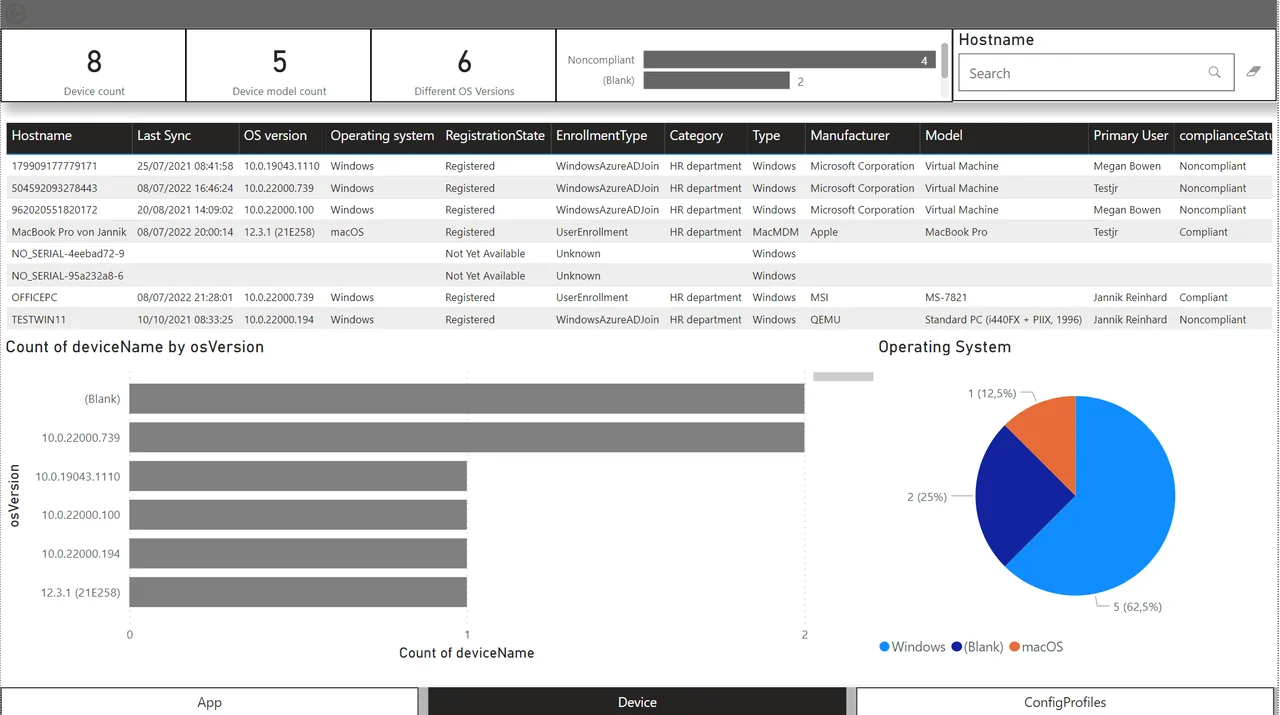
Table of contents
What is the Intune Data Warehouse
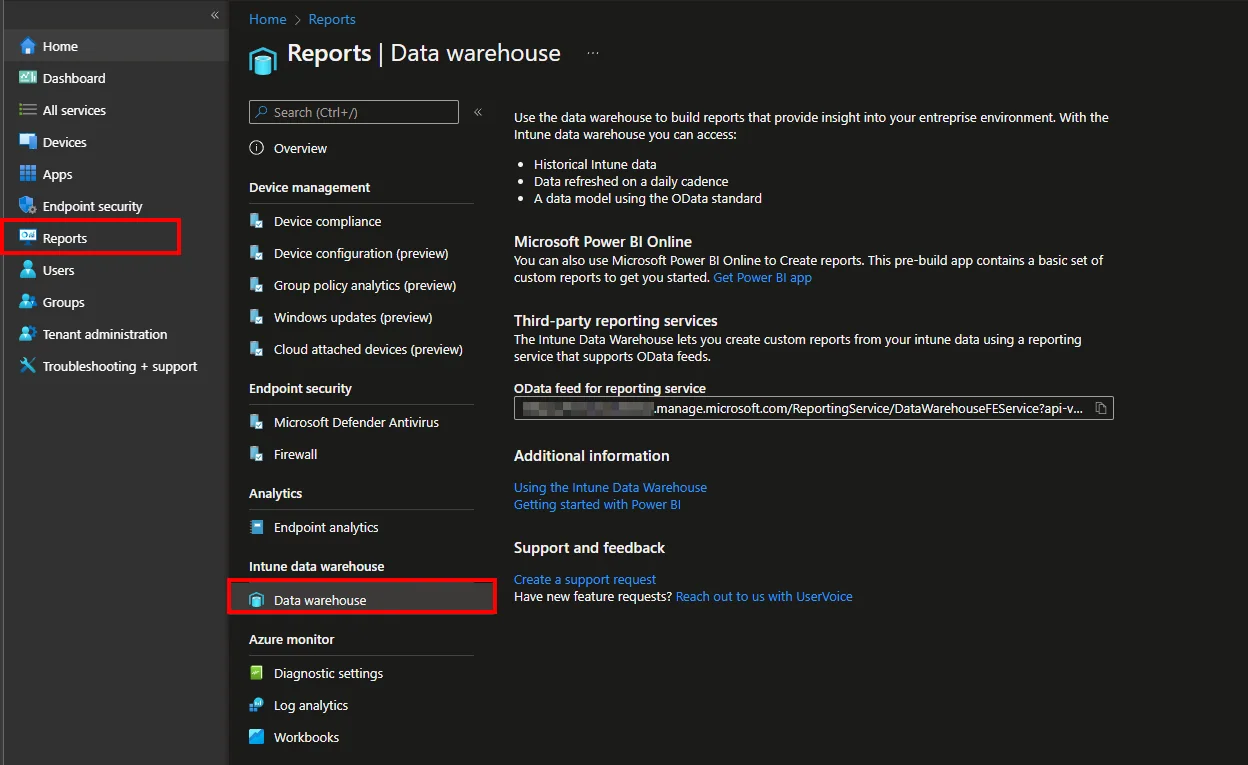
The Intune Data Warehouse is a collection of multiple structured data tables that are linked together through relations, designed specifically for reporting purposes. It uses the OData model, so you can access both daily snapshots and historical data going back several weeks. One important detail to remember is that the Intune Data Warehouse only surfaces Intune-managed devices – co-managed devices have to be retrieved separately via Configuration Manager. You can find the OData feed string in the Intune admin center under Reports -> Data warehouse, and that single URL is the key that unlocks every table for your reports.
Because the data is already modelled and normalised, you spend far less time wrangling raw exports and far more time analysing trends such as compliance, configuration drift, and application rollout. If you want to go even further with reporting, take a look at my post on Intune advanced analytics for a comparison of the native options.
Useful links:
Install Power BI Desktop on your device
Before you can query any tables, you need the right tool. Power BI Desktop is free and ships with a dedicated connector that knows how to authenticate against the warehouse, so there is no need to handcraft the OData URL.
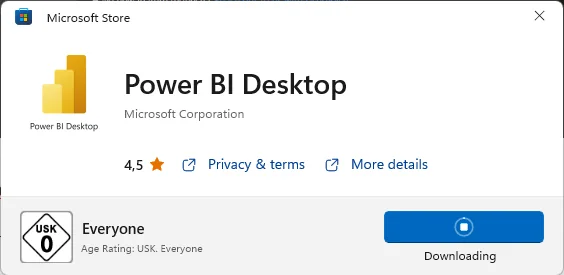
- Download and install Power BI Desktop from the Windows Store
Access the Intune Data Warehouse in Power BI
With Power BI Desktop installed, the next step is to access the Intune Data Warehouse using the built-in connector. Follow the steps below and you will have live tables loaded into your model in just a few clicks.
- Open Power BI Desktop
- Select Get data
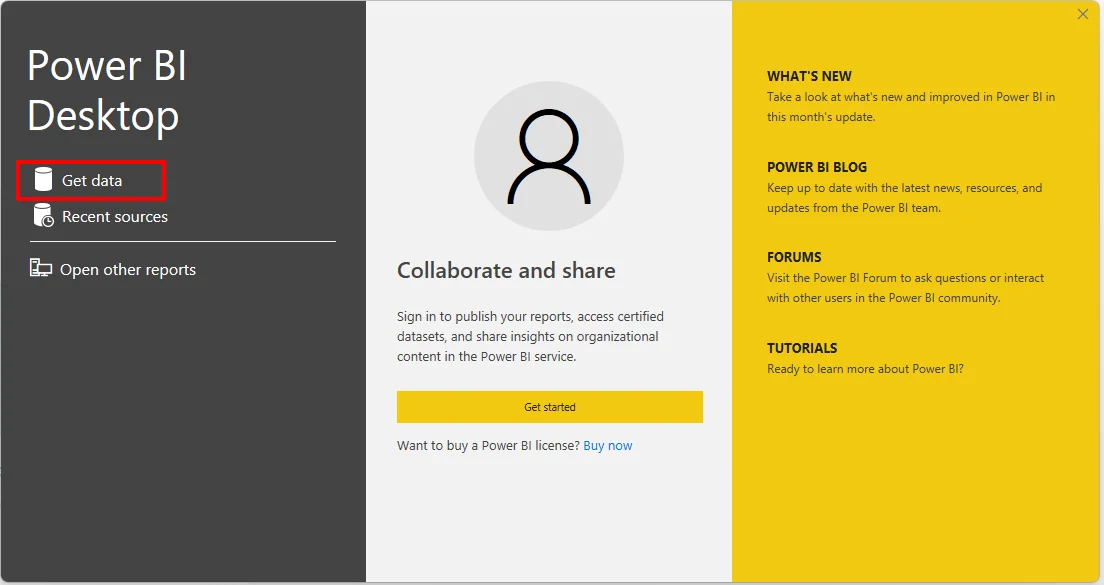
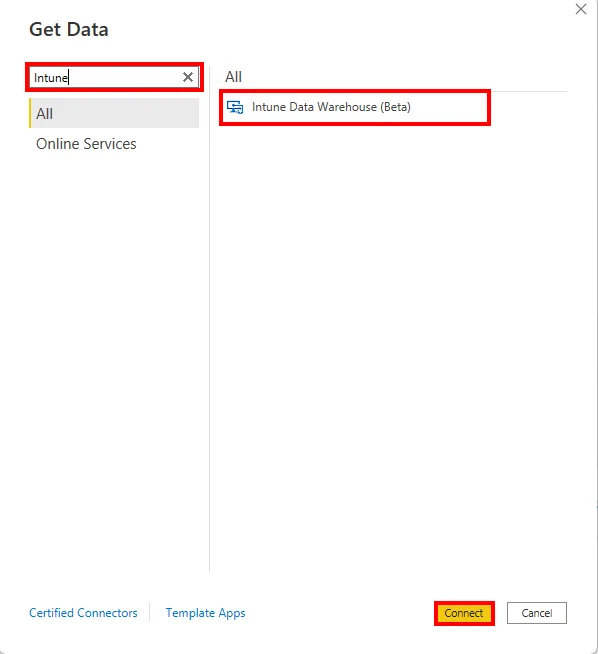
- Search for Intune Data Warehouse and click Connect
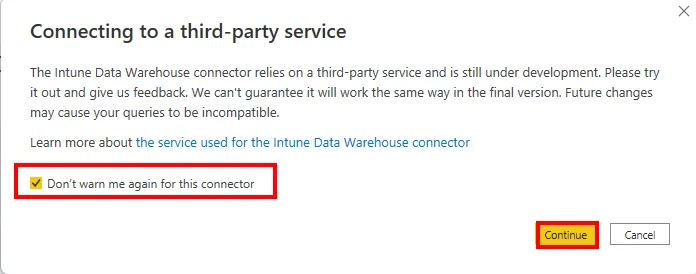
- Select Don’t warn me again for this connector and click Continue
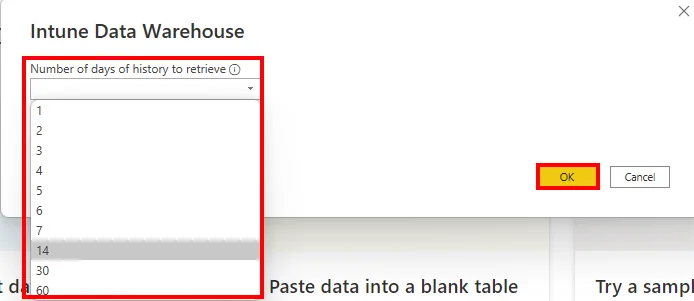
- Select the history you want to have and click OK
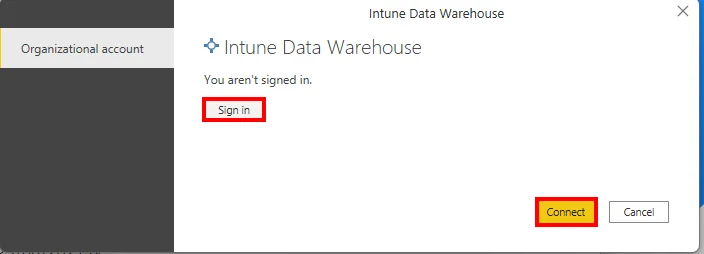
- Click Sign in and authenticate with your account
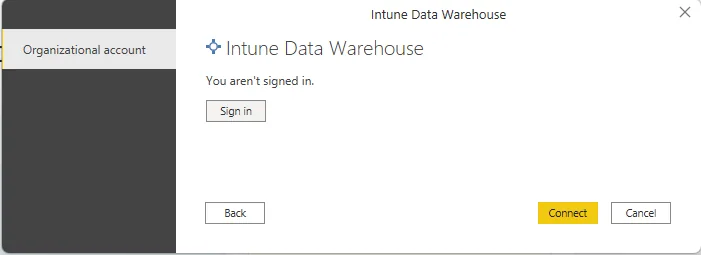
- Click Connect
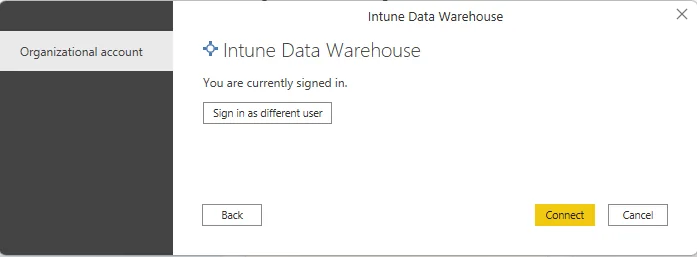
- Select the Tables you need for the reporting
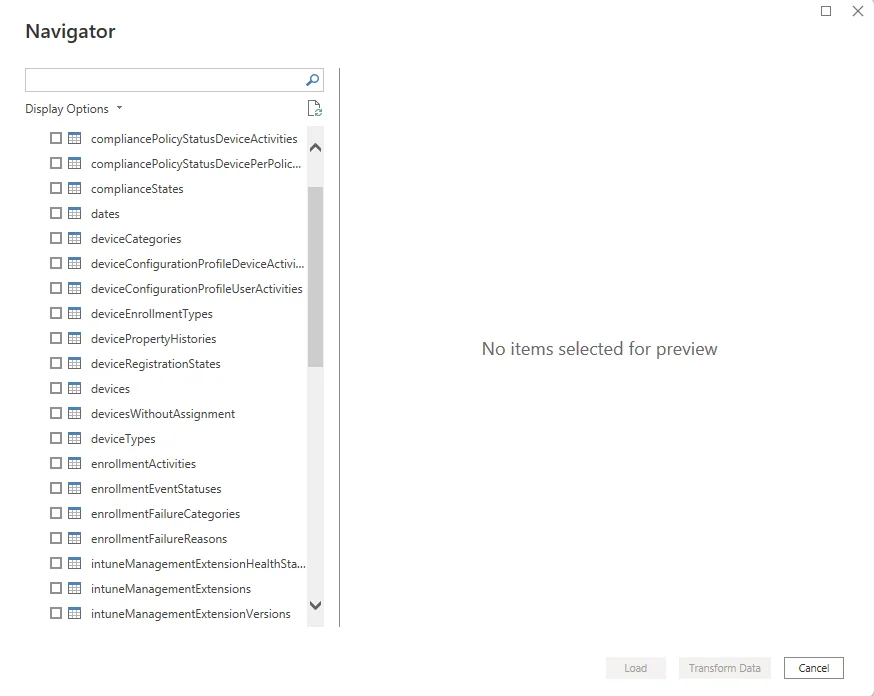
If you only need a high-level overview, start with the device, application, and configuration tables. You can always add more tables later, but pulling everything at once will slow down the initial load considerably.
Import the ready-to-use Intune Data Warehouse dashboard
Rather than building every visual from scratch, you can import my ready-to-use dashboard that is already wired up to the Intune Data Warehouse model. After downloading the file, you only need to point it at your own tenant and refresh.
- Download the Intune Dashboard from my Github repository
- Click refresh
- Sign in with your credentials
- Have fun with the dashboard
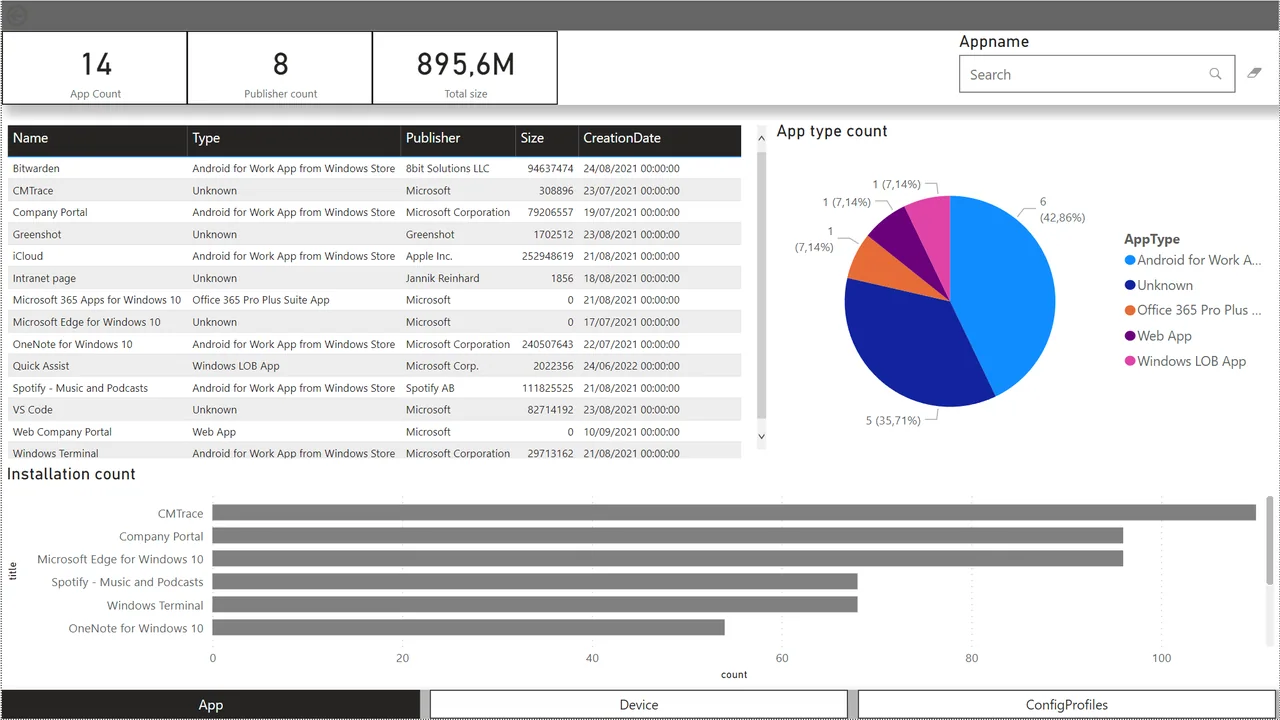
App View
The app view aggregates application install status across your fleet so you can quickly spot failed deployments and adoption gaps.
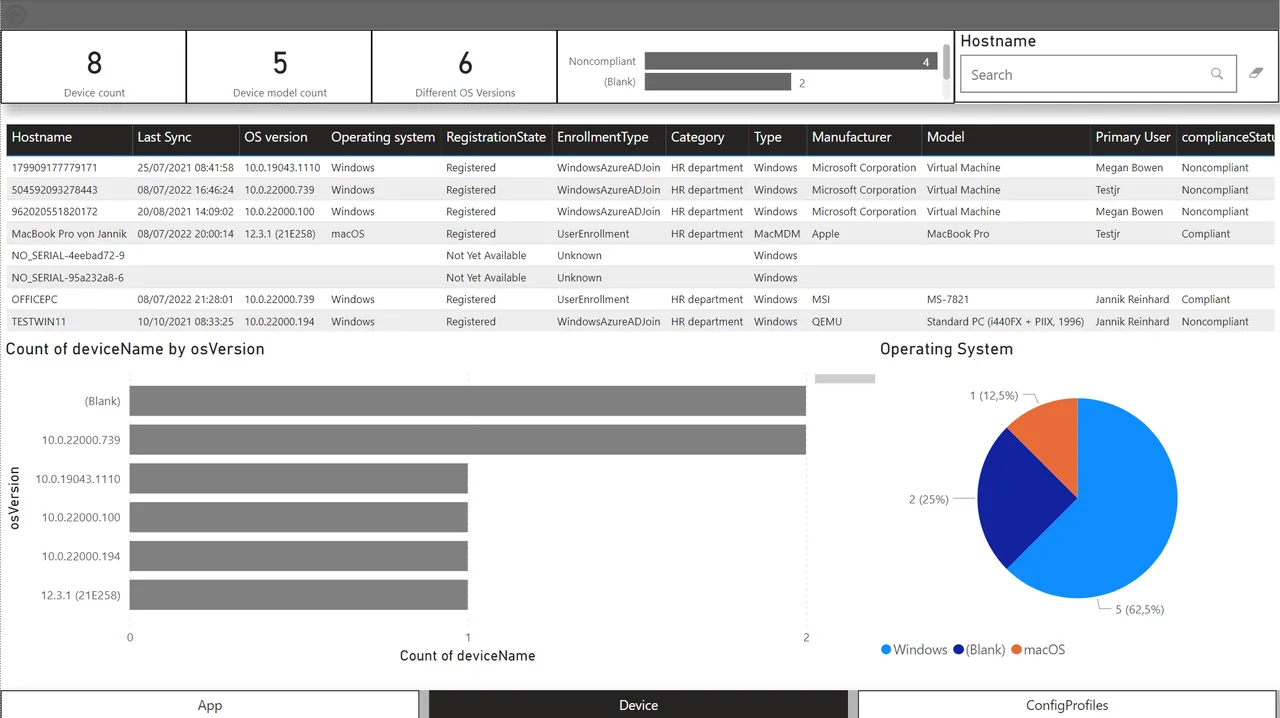
Device view
The device view breaks down enrollment, operating system, and ownership so you can track the health of every managed endpoint.
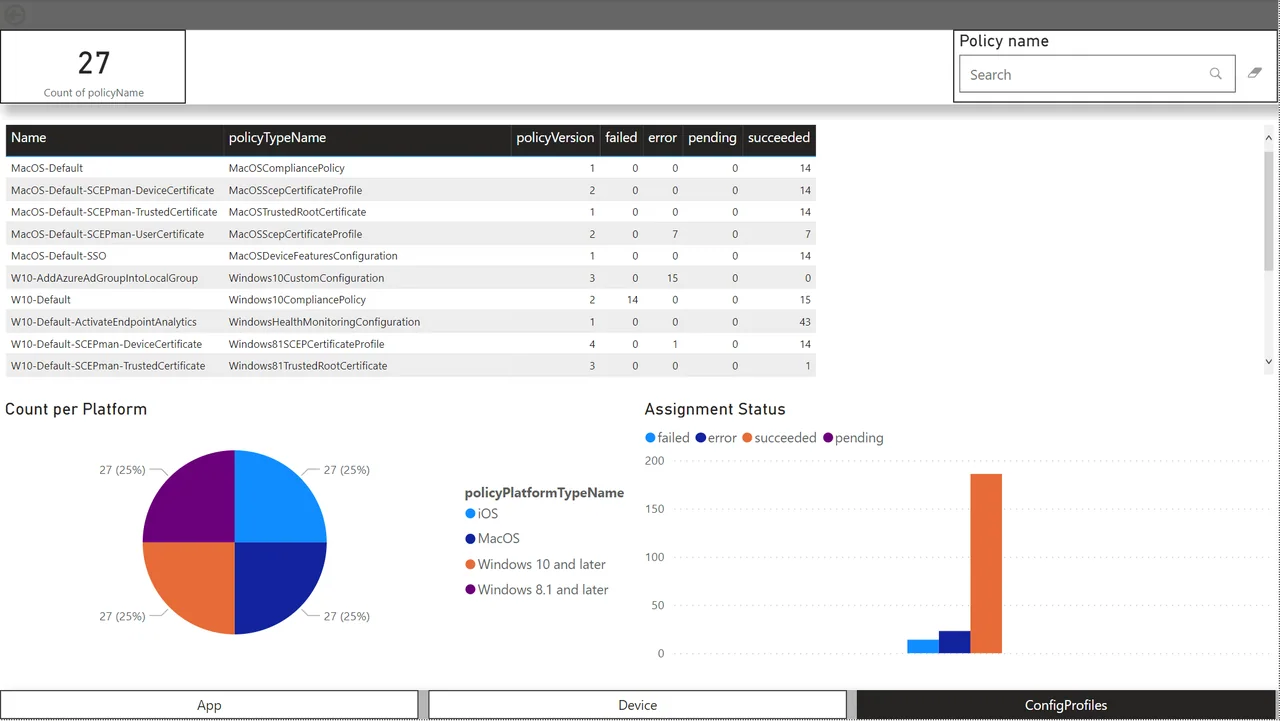
Config Profile
The configuration profile view reports assignment results so you can confirm that policies actually land on the devices you targeted.
Conclusion
With this dashboard you get a high-level overview of your environment in minutes, all powered by the Intune Data Warehouse. You can extend it with other data sources, expand it further, and customize it for your own needs – and the best part is you don’t have to worry about the design. Once you are comfortable connecting Power BI to the Intune Data Warehouse, reporting on your Intune estate becomes a repeatable, automated routine rather than a manual chore.
Stay healthy, Cheers
Jannik
11.02.2023: Error 0x80040E4E
If you got this error you have to change the regional setting: https://learn.microsoft.com/en-us/power-bi/fundamentals/supported-languages-countries-regions
[…] And you can read his full post here: Build PowerBi Dashboard based on Intune Data Warehouse – Modern Device Management (jannikreinhard.… […]
[…] https://jannikreinhard.com/2022/07/10/build-powerbi-dashboard-based-on-intune-data-warehouse/ […]
[…] Build PowerBi Dashboard based on Intune Data Warehouse […]
The dashboard looks nice but when I try to refresh the data I get the following error:
OLE DB or ODBC error: Exception from HRESULT: 0x80040E4E.
I think it’s related to Regional settings but I can’t find a setting that allows the data connection to complete. Any thoughts?
It looks like that this is an issue with the encoding and an strange character. Can you give me more details from this error message. You can also check this: https://community.powerbi.com/t5/Desktop/0x80040E4E-Error-OLE-DB-or-ODBC/m-p/116683
Can you try this: https://learn.microsoft.com/en-us/power-bi/fundamentals/supported-languages-countries-regions
Sorry, I overlooked your reply. Just had a chance to review your response and test a few things. I enabled tracing and grabbed the error from the logs. Here is the error, which doesn’t mention language support or unusual characters.
DataMashup.Trace Error: 24579 : {“Start”:”2023-02-18T18:09:45.7086982Z”,”Action”:”PBI.TraceMessage”,”sessionId”:”xnxnxnxnxnxnxnxnxnx”,”deviceId”:”xnxnxnx”,”userId”:”xnxnxnxnxnxnxnxnxnx”,”isInternal”:”False”,”authenticatedUserId”:”xnxnxnxnxnxnxnxnxnx”,”Message”:”ASOperationException with failed queries in ApplyQueriesToModel.Details:Type=Microsoft.AnalysisServices.OperationException, Message=Failed to save modifications to the server. Error returned: ‘Column ‘platform’ in Table ‘mamApplicationInstances’ contains a duplicate value ‘3’ and this is not allowed for columns on the one side of a many-to-one relationship or for columns that are used as the primary key of a table.
OLE DB or ODBC error: Exception from HRESULT: 0x80040E4E.
The current operation was cancelled because another operation in the transaction failed.
‘., ASErrorCode=3241541694|3238395904|3238395904|3238395904|3238395904|3238395904|3238395904|3238395904|3238395904|3238395904|3238395904|3238395904|3238395904|3238395904|3238395904|3238395904|3238395904|3238395904|3238395904|3238395904|3238395904|3238395904|3238395904|3238395904|3238395904|3239837702|3238395904|3238395904|3238395904|3238395904|3238395904|3238395904, StackTrace=at Microsoft.AnalysisServices.Tabular.Model.SaveChangesImpl
at Microsoft.PowerBI.Modeler.ModelManager.c__DisplayClass248_0.b__0
“,”ProductVersion”:”2.114.664.0 (23.02)”,”ActivityId”:”00000000-0000-0000-0000-000000000000″,”Process”:”PBIDesktop”,”Pid”:38872,”Tid”:104,”Duration”:”00:00:00.0000175″}
Same error here: OLE DB or ODBC error: Exception from HRESULT: 0x80040E4E.
It looks like that this is an issue with the encoding and an strange character. Can you give me more details from this error message. You can also check this: https://community.powerbi.com/t5/Desktop/0x80040E4E-Error-OLE-DB-or-ODBC/m-p/116683
Can you try this: https://learn.microsoft.com/en-us/power-bi/fundamentals/supported-languages-countries-regions
Same error
Same Error as welll – hmmmm – any ideas?
OLE DB or ODBC error: Exception from HRESULT: 0x80040E4E.
It looks like that this is an issue with the encoding and an strange character. Can you give me more details from this error message. You can also check this: https://community.powerbi.com/t5/Desktop/0x80040E4E-Error-OLE-DB-or-ODBC/m-p/116683
Its a bit weird since it seems to generate the error based on the intune tenant not from where the report is runned? Both are running from power bi desktop latest version.
This tenant works:
Tenant location
Europe 0202
MDM authority
Microsoft Intune
Account status
Active
Service release
2301
This one does not:
Tenant location
Europe 0601
MDM authority
Microsoft Intune
Account status
Active
Service release
2301
More details of the errors:
enrollmentActivities
Column ‘dateKey’ in Table ‘enrollmentActivities’ contains a duplicate value ‘20230130’ and this is not allowed for columns on the one side of a many-to-one relationship or for columns that are used as the primary key of a table.
enrollmentFailureCategories
OLE DB or ODBC error: Exception from HRESULT: 0x80040E4E.
Did you saw my comment on the bottom of the blog how to fix 0x80040E4E. Did this hel?
I only see à reference to change regional settings but from What? And What to?
You have to change the Region in PowerBi to solve your issue. The regional settings are the problem with the character support. Know this is a bit confusing but it helps. Check this:
https://community.powerbi.com/t5/Desktop/0x80040E4E-Error-OLE-DB-or-ODBC/m-p/116683
hmm ive tried from Us to german .. same, keeps working for the tenant above that works but same errors for the one that did not work :/