
Copilot, Claude or ChatGPT? Where your company data goes
Compare plans, real costs and EU processing options for Microsoft 365 Copilot, Claude Code and Codex before choosing a service for your team.
“What’s the last day we can cancel this agreement?” Ask Copilot, Claude or ChatGPT, and the first thing you want back is a date. Your IT team has a second question. Where does the model read the contract text? You may already store the file in the EU. Whether the relevant paragraphs can travel to another country for processing is a separate decision. Two plans can cost the same per seat and give you different answers.
Take a maintenance agreement in SharePoint. One colleague asks for the cancellation deadline and the clause it comes from. Another asks the agent to add a reminder two weeks before that date. Now the date lives in a calendar as well. If the reminder fires on the wrong day and someone pastes the clause into a support ticket, there’s another copy. I’ll use that agreement to work through the cost for 25 people and follow the text from the PDF to the support desk.
I checked the public prices and terms on 28 November 2026. The cost examples are for a company in Germany. The locations below come from provider agreements, model cards and product documentation. Availability in your tenant still needs a test before you sign off.
Which Copilot options and alternatives are we comparing?
| Product or access level | What you get |
|---|---|
| Copilot Chat (Basic) | Business chat grounded in web information. To ask about your agreement, upload the PDF or paste the relevant clause. This tier gives you chat outside Word, Excel, PowerPoint and OneNote. Microsoft’s licence overview |
| Microsoft 365 Copilot (Basic) | Also available without a Copilot add-on. This level adds Copilot in supported Office apps, for example when you want to work on the document already open in Word. The two Basic access levels |
| Microsoft 365 Copilot (Premium) | The paid Copilot experience. With Work IQ enabled, Copilot can draw on emails, files and meetings you have permission to access through Microsoft Graph. It also includes the full Copilot experience in the Office apps. Premium capabilities |
| Copilot Cowork | An agent that can look up a contract deadline and create a calendar event as steps in one task. It needs a qualifying paid Copilot licence and an assigned spending policy that enables Cowork. Usage is metered in Copilot Credits. What Cowork can do · Cowork access |
| Microsoft Copilot Studio | A platform for building agents and publishing them to internal or external channels. You choose the knowledge sources, authentication and actions. Studio licensing |
| Claude | Anthropic’s workspace for chat, documents and projects. Team and Enterprise are the direct business plans. A separate desktop deployment lets you send model requests through your own cloud account. Claude plans · Cloud deployment |
| Claude Code | Anthropic’s coding agent for the terminal and IDE. It can read or change project files and run commands. Signing in with a Claude organisation and connecting the client to a cloud provider give you different contracts and bills. Claude Code seats |
| ChatGPT | OpenAI’s workspace for chat, file analysis and research with admin-managed apps. The relevant plans here are Business and Enterprise. Plan comparison |
| Codex | OpenAI’s coding agent. It works against a local project or in a managed cloud environment. The CLI can also connect to your Azure endpoint or a model you run yourself. Codex plans · Azure integration |
Which Copilot do you have? Sign in to the Copilot app with your work account. Look under your name at the bottom of the home screen for Copilot Chat (Basic), M365 Copilot (Basic) or M365 Copilot (Premium). If your organisation already pays for Microsoft 365 Business Premium, check whether the user also has the Copilot add-on. The base subscription name alone won’t tell you. Microsoft 365 Premium for a personal Microsoft account is a separate consumer subscription. Check your licence · Business subscriptions · Microsoft 365 for individuals
What would 25 seats cost?
Microsoft publishes German prices in euros before VAT. I have kept the public Anthropic and OpenAI prices in US dollars. These are monthly equivalents on an annual billing cycle. Where I convert to euros I use a planning assumption of EUR 0.90 per dollar.
| Licence or usage | How it is billed | Monthly cost for a team of 25 |
|---|---|---|
| Copilot Chat (Basic) and M365 Copilot (Basic) | No additional seat charge with an eligible Microsoft 365 plan | EUR 0 extra for the included chat. Enabled, metered agents may incur charges. Entitlements |
| Copilot Premium through Microsoft 365 Copilot Business | EUR 18.20 per person. Eligible existing customers can buy at EUR 15.60 for the first year until 31 December 2026 | EUR 455 at list price or EUR 390 in the promotional year. Business covers organisations with up to 300 users. German business pricing and offer terms |
| Copilot Premium through Microsoft 365 Copilot for enterprise | EUR 26 per person | EUR 650 for 25 additional licences. Count only the paid Copilot seats you still need to buy. German enterprise pricing |
| Copilot Cowork | Metered usage on top of the qualifying licence. Pay-as-you-go costs USD 0.01 per Copilot Credit | If the team uses 25,000 credits in total, usage costs USD 250 or EUR 225 at the exchange rate used here. Copilot Credit billing |
| Claude Team | Standard USD 20 or Premium USD 100. Monthly billing is USD 25 or USD 125 | USD 500 for 25 Standard seats, about EUR 450. Both include Claude Code. Premium offers five times the Standard allowance. Pricing · Code access |
| Claude Enterprise on the current plan | USD 20 per seat plus token usage from the first request | USD 500 in seat fees for 25 people on self-service. Add USD 250 of example usage and you get USD 750, about EUR 675. The minimum is 20 seats online or 50 through sales. Pricing · Enterprise terms |
| ChatGPT Business | Standard USD 20 or Premium USD 100. Monthly billing is USD 25 or USD 125 | USD 500, about EUR 450, for 25 Standard seats with Codex within the plan limits. A new workspace can start with one paid seat. Business billing |
| ChatGPT Enterprise | Quoted individually | Ask for the seat commitment, included capacity, overage, support and term before putting a number in the annual budget. Enterprise plan · Usage billing |
Copilot Studio is priced at tenant level. Microsoft lists EUR 173.30 per month for 25,000 Copilot Credits in Germany, with pay-as-you-go as another option. A paid M365 Copilot seat includes certain internal agent use in the user’s context on supported channels. If you publish the same agent on an external website, check that channel separately. The number of people who built an agent tells you little about the cost of running it. Copilot Studio pricing · Included agent use
What heavier usage costs across 25 seats
Suppose five of the 25 colleagues regularly run long coding tasks. With both Claude Team and ChatGPT Business you could buy 20 Standard and five Premium seats. At annual rates that is 20 × 20 + 5 × 100 = USD 900 a month, roughly EUR 810. A developer who uses chat and coding counts once. I would let the pilot tell me how many people need Premium. The providers meter their own allowances, so matching seat prices do not tell you how many completed code changes you will get. Claude Team · ChatGPT Business seats
What if only some people need Cowork? Say 20 colleagues stay on Copilot Chat and five get new Copilot Business seats. At list price, that’s 5 × EUR 18.20 = EUR 91 per month. If those five use 25,000 credits between them, add EUR 225 at our planning rate. That takes the monthly bill to EUR 316 on top of the existing base licences. If all 25 need the paid Copilot experience and total usage stays the same, it comes to EUR 455 + EUR 225 = EUR 680. For a pilot I would record credits per completed task, including the weekly job that runs when nobody opens chat. Copilot Credits Guide · Cowork administration
For Claude Enterprise, ask which order form you are reading. Anthropic still documents older seat-based agreements. On the current metered plan, the very first long conversation adds usage charges. With 25 active users but a sales-assisted minimum of 50 paid seats, you would start at USD 1,000 a month before any of the 25 people use Claude. The self-service minimum changes that calculation. Anthropic’s Enterprise billing models
Which part of the agreement has to stay in the EU?
Trace a paragraph of the maintenance agreement. The original is in SharePoint. Some text goes to the model, its answer can land in a conversation or an agent transcript, and the due date ends up in a calendar. Deleting the conversation leaves other records to deal with. These are the five questions I would take to your data protection team.
| Requirement | Evidence to ask for |
|---|---|
| Storage | Countries for conversations, uploaded files, indexes, replicas and backups. Who retains the paragraph after delivering the answer? |
| Inference | Model ID, deployment type, permitted destination regions and the behaviour when capacity runs out. Is the provider allowed to process requests elsewhere for a minute? |
| Other processing | Destinations for web searches, text extraction, tool arguments and logs. Does the calendar action need the whole conversation or just a date and a subject? |
| Human access | Where can the provider, implementation partner and your administrators access content from, including during an outage? |
| Deletion | Which objects can the user delete? How long do files, agent runs, safety copies and backups survive? Who can answer an access or erasure request? |
Microsoft’s EU Data Boundary includes the EU and EFTA. OpenAI calls its European region the EEA plus Switzerland. Both therefore include Norway, Iceland, Liechtenstein and Switzerland. A contract specifying “member states of the European Union” sets a narrower limit. A German-only requirement narrows it again. I would put the agreed countries in the purchasing document before anyone selects a region called Europe. Microsoft’s boundary · OpenAI’s region definition
What protection comes with the Microsoft tenant?
When a user signs in with a business Entra account, eligible Copilot Chat and Microsoft 365 Copilot experiences have enterprise data protection. Microsoft processes prompts, responses and data retrieved through Microsoft Graph within the documented commercial framework and does not use them to train the underlying foundation models. For our PDF I would start by opening the SharePoint library’s permissions. If a pilot group can already read every confidential agreement, a Copilot with access to the library can make those files easier to find. Choosing the correct data region does not repair those permissions. Enterprise data protection · Copilot privacy
I would use the same maintenance agreement for three privacy checks. With Copilot Chat, check which clause the user actually put into the chat. With Copilot Premium, also check whether that account can discover a confidential amendment through search. With Cowork, open the resulting calendar event. Does it show just the deadline, or has it copied a sensitive part of the clause into the description? Someone with access to the shared calendar may be able to read that entry even if they cannot open the contract library. Decide which calendar Cowork can write to and which fields belong in the event. Work data and permissions · Cowork actions and permissions
Storage and flex routing. For eligible tenants, Microsoft makes commitments about stored Copilot interactions and the associated semantic index. With Advanced Data Residency, check the sign-up country, licence coverage across the tenant and any required migration. Model inference has its own control. Flex routing is on by default for eligible tenants created after 25 March 2026. If inference must stay inside the EU Data Boundary even under peak demand, check the policy in the Microsoft 365 admin center and retain evidence that it is off. Microsoft excludes tenants that have purchased or used M365 Multi-Geo from this particular M365 boundary commitment. In that case the normal flex routing switch is unavailable. Copilot storage commitments · Flex routing and Multi-Geo
Web search. Suppose our colleague also asks about the financial position of the supplier. Copilot can generate a Bing query using terms informed by that prompt, possibly the supplier or project name. Microsoft acts as an independent controller for generated web queries. Its M365 DPA and the EU Data Boundary do not cover those queries. For a group checking cancellation clauses I would disable web search. The contract already contains the information the reader needs. Data sent to Bing
Cowork and Studio. Cowork can write its deliverables to OneDrive or SharePoint and invoke other tools. Its FAQ currently lists GPT models for organisations inside the EU Data Boundary. Microsoft has announced Claude inside that boundary for eligible customers by the end of 2026. Before turning on Claude in Cowork, check whether Microsoft has confirmed processing inside the boundary for your tenant. In Studio, inspect the Power Platform environment, cross-region processing, flex routing and each connector separately. There are also two places to look for transcripts. Admins can control Dataverse transcripts, while the Studio service can retain session information for up to 28 days of its own. Cowork FAQ · Microsoft announcement · Power Platform regions · Studio transcripts
Microsoft also documents operational situations in which personnel outside the boundary can access data remotely. Microsoft treats that as a transfer even when the support device retains no persistent copy. If the agreement restricts incident response to EU-based personnel accessing data from the EU, procurement needs a commitment that addresses that particular access. Documented operational exceptions
What does Claude Enterprise change compared with Team?
For a direct German customer the Commercial Terms name Anthropic Ireland, Limited as the contractual entity. A Data Processing Addendum governs processing on the customer’s behalf. Business content is excluded from model training by default. Review voluntarily submitted feedback and any separate agreement to share data on their own terms. Anthropic documents US storage by default for its direct service, with processing across multiple countries. The direct API’s published values for inference_geo are global and us. Neither selects EU-27 inference. Commercial Terms · Anthropic DPA · Storage locations · API regions
There are good reasons to buy Enterprise. SCIM lets you remove a departing developer centrally. Audit logs help you find who changed the organisation’s settings. Custom retention and customer-managed keys for supported content address different requirements again. A Team Premium seat primarily buys additional usage. If your data protection officer needs an enforced retention period, have sales identify which chats, files and integrations the rule covers. A customer-managed key gives you control over a key. It does not establish the location of the GPU that processes a permitted request. Enterprise controls · Retention
The Microsoft 365 connector is worth checking with the PDF. A user can retrieve a paragraph they are authorised to read and bring it into a Claude conversation. That copy now has the lifecycle of the conversation. Revoking access to the SharePoint source tomorrow affects future retrieval. You still need to account for the text copied yesterday, just as you would for a file the user has already downloaded. Anthropic’s M365 connector security guide
How can Claude process requests inside EU member states?
For that requirement I would look at Claude Desktop or Claude Code using Amazon Bedrock in your own AWS account. With the desktop client configured for this provider, model requests go through AWS and conversation history lives on the device. The laptop and its backups now belong on the data-flow diagram. Shared web projects, cross-device history and mobile access differ from the direct Claude workspace. That can change the buying decision if shared projects were the very reason the department selected Claude. Claude Desktop on a cloud provider · Provider comparison
Open the AWS model card for Sonnet 4.6 and look at just one row. Choose the profile eu.anthropic.claude-sonnet-4-6 with the source region eu-central-1, Frankfurt. AWS lists destinations in Germany, Sweden, Italy, Spain, Ireland and France. Call the very same profile from Zurich and Zurich is also a possible destination. Call it from London and London joins the list. All three carry the same eu. prefix. Record the source region in the operating instructions and restrict it in the account permissions. Allowing an automatic global fallback would reopen the boundary you just agreed. AWS Sonnet 4.6 model card · Geographic inference permissions
If processing has to stay in one country, AWS documents In-Region inference for Claude Opus 5 in Stockholm or Ireland through the bedrock-mantle endpoint with model ID anthropic.claude-opus-5. Select one region. Verify account access, quota and every additional model the coding client can call, including for short background tasks. Record the approved models and region. Test that a request fails if there is no capacity in that region. AWS Opus 5 model card · Claude Code on Bedrock · Claude Desktop on Mantle
Can we do this through Microsoft Foundry? If your team already uses Azure, it makes sense to check Foundry first. Microsoft distinguishes Anthropic hosting from Azure hosting for Claude. The published choices are Global Standard and US Data Zone for supported Azure-hosted models. That list does not establish a European inference route for Claude. There are CSP subscription restrictions, too. If you already use Google Cloud, there is another option. For Google-managed Sonnet 4.6, the model card lists the endpoint europe-west1 and the European multi-region for ML processing. Google restricts its EU multi-region to EU member states, excluding the UK and Switzerland. You can document that EU boundary here. The Belgian endpoint name alone cannot promise processing only in Belgium. Foundry hosting · Subscription eligibility · Google model card · Google regional commitments
What does Europe cover in ChatGPT?
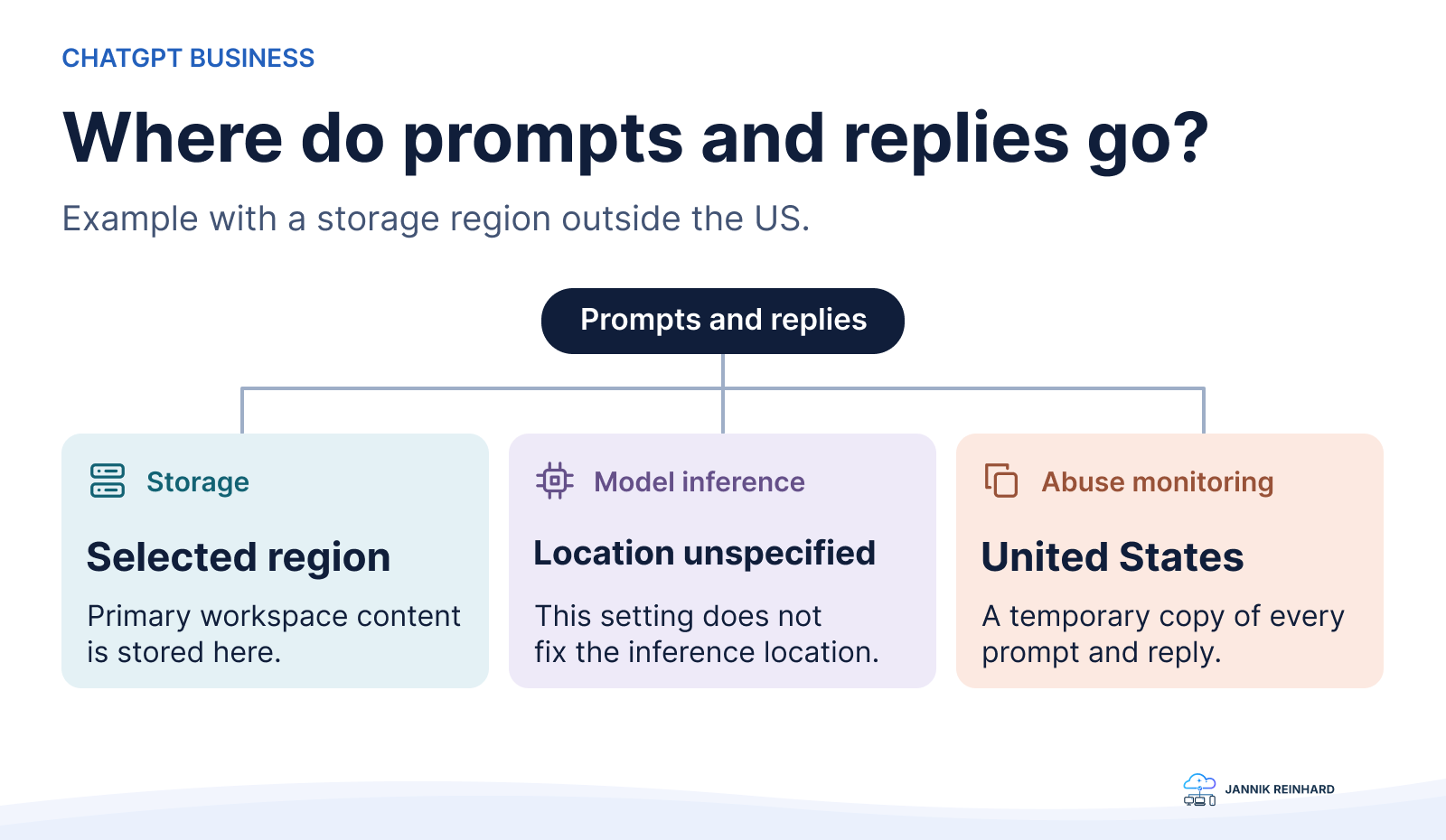
With ChatGPT Business, read the primary storage statement all the way through. Eligible new workspaces can choose a storage region at checkout. If that region is outside the US, OpenAI also keeps a temporary US copy of every prompt and response for safety, abuse monitoring and enforcement. The abuse-monitoring logs are in the US too. Even a single paragraph pasted from the maintenance agreement follows that route. Buying Premium seats does not change it. Where OpenAI stores Business content
An eligible direct ChatGPT Enterprise workspace can have two commitments. Data residency covers storage of the listed customer content, including backups and replicas. Inference residency covers GPU processing for supported features and requires storage residency in the same region. Ask to see both values for your workspace. Europe here means the EEA and Switzerland. Authentication, certain CPU operations, system metadata, external apps and web search each have a different scope. There is also a procurement detail I would check before accepting a quote. If you buy ChatGPT Enterprise through AWS Marketplace, OpenAI offers inference residency only in the US through that channel. Enterprise data and inference residency
An Enterprise agreement can also give you central retention settings, SCIM and additional administrative controls. OpenAI excludes business data from model training by default. For a deletion test, try the conversation and the associated file separately. A file saved in a library or a project can have its own lifecycle. OpenAI normally schedules a deleted chat for permanent deletion within 30 days, subject to its documented exceptions. The DPA describes assistance with data subject requests, deletion and sub-processors. Enterprise privacy · Chat and file retention · OpenAI DPA
What if our application calls the API directly?
Say procurement wants the cancellation date displayed inside its contract management application. Your backend now reads the paragraph and calls a model API. Owning a ChatGPT Business seat does not configure this API project or select its region. Eligible OpenAI customers can set up a regional project for supported endpoints and models. The European hostname is eu.api.openai.com. Europe again means the EEA and Switzerland. Check the project’s abuse-monitoring agreement and whether the feature you intend to call persists application state. A file object or an external tool may need its own deletion step even when the individual model request is stateless. OpenAI API regions · Data controls by endpoint
Zero data retention (ZDR) describes an agreed retention policy. The country in which a GPU runs is a separate question. For Claude, the model choice can change the retention terms too. Anthropic documents 30-day safety retention of prompts and outputs for the models it designates as covered models, with conditions for exceptions. If you have promised a deletion window, a model upgrade belongs in the approval process. Anthropic’s covered-model rules
What leaves the developer’s device in Claude Code and Codex?
Imagine a failing unit test in the code that reads the maintenance PDF. The coding agent can open the parser, run the test and send terminal output back to the model. If that output contains a customer file path or a snippet of a production log, it can become part of the next model request. A small test repository and a made-up agreement are enough for a pilot. Check command output, local session files and permissions for additional tools alongside the source code. Claude Code data usage · Codex administration
Codex Cloud adds a remote working copy. OpenAI lists Codex among the customer content supported by residency. That does not settle the country of the VM, the repository host, CI, package services or every network call. Codex Cloud also documents recoverable VM state with its own window of up to seven days from the last start or resume. If the requirement says “source code stays in the EU”, ask specifically about that working copy. Codex Cloud · Scope of residency
If your team wants to use Codex and needs model processing to stay in Germany, I would look at Codex CLI with Azure OpenAI in Foundry. Microsoft’s matrix lists gpt-5.4, version 2026-03-05, under Regional Provisioned Managed in Germany West Central. Read the regional deployment section. A resource created in Frankfurt can still use a global deployment type. The EU Data Zone can include EFTA countries. The acceptance test therefore needs the model version, local capacity, a supported Responses API deployment and a working client connection. Request a quote for the required provisioned throughput units (PTUs). A Data Zone token price is the wrong input for pricing this reservation. Codex on Azure · Regional model matrix · Deployment types · Azure data handling
There is a self-hosted option. Codex CLI supports --oss with Ollama or LM Studio. With an OpenAI open-weight model such as gpt-oss-20b, you can run the model, repository and logs on your own infrastructure. For a strict boundary, repeat a complete task with outbound internet blocked after provisioning. Disable external tools and include remote administration and backups in the approved locations. The model weights are available under Apache 2.0. Price the hardware, electricity and support, and test whether the local model can complete the same coding work the team expects from the hosted product. Local CLI options · OpenAI open-weight models
How much extra does regional inference cost?
For a worked example I use 10 million input and 2 million output tokens a month, with no caching, batch discount or extra tools. These are Amazon Bedrock prices in USD. Comparing two rows of the same model isolates the extra cost attributable to the routing choice for this volume. Anthropic’s 9 November 2026 model price list
| Model and route | Input / output per million tokens | Monthly inference cost |
|---|---|---|
| Sonnet 4.6, global | USD 3.00 / 15.00 | 10 × 3.00 + 2 × 15.00 = USD 60 |
| Sonnet 4.6, EU profile from Frankfurt | USD 3.30 / 16.50 | USD 66, an extra USD 6 |
| Opus 5, global | USD 5.00 / 25.00 | USD 100 |
| Opus 5, single region through Mantle | USD 5.50 / 27.50 | USD 110, an extra USD 10 |
Those USD 66 pay for model calls. Delivering a managed desktop to 25 colleagues also takes device management, setup and support. Short and long coding tasks have very different token counts. With the same test repository I would track cost per accepted change that passes its test. Procurement can then compare the existing seat and the regional endpoint against work the team recognises.
For the deployment types in the portal, my Foundry model deployment guide walks through the choices.
How I would document the GDPR decision
The GDPR allows international transfers under certain conditions. It also requires a defined purpose, a lawful basis and appropriate safeguards. An agreement your organisation signs can impose a stricter geographic limit. Switzerland makes a good example. The European Commission recognises it as adequate. If the agreement nevertheless requires administration exclusively from EU member states, a support engineer connecting from Switzerland falls outside that agreement. The same limit applies if your external IT support team is based there. GDPR, particularly Articles 5, 6, 28, 32 and 44 onwards · Commission adequacy decisions
- Write down the purpose with a document in front of you. To check a cancellation deadline, the model needs the clause, the agreement term and possibly the signature date. It seldom needs the signature itself, bank details or a private phone number. Record who checks the answer and which fields reach the calendar. Consider Article 9 if special categories of data are involved and national rules for employee data where relevant. If the proposed processing is likely to create high risk, Article 35 requires a data protection impact assessment before it starts. GDPR · German data protection authorities’ AI guidance
- Name the parties and recipients. For Microsoft, collect Product Terms and the DPA. For direct Claude, collect the Commercial Terms and Anthropic’s DPA. For OpenAI, collect the Services Agreement and DPA. For Bedrock in your own account, include the AWS agreement, AWS DPA and model terms. Who can see the clause when someone opens a support ticket? If an external IT provider processes personal data on your behalf, document its role and your instructions in the data processing agreement. An Article 28 agreement needs to cover instructions, sub-processors, security, assistance and return or deletion of data, among other obligations. Microsoft DPA · Anthropic DPA · OpenAI agreement · OpenAI DPA · AWS DPA
- Document the mechanism for each third-country transfer. An adequacy decision must cover the recipient and processing in question. For a US recipient relying on the EU-US Data Privacy Framework, check the specific company’s current certification. If you rely on standard contractual clauses, assess the transfer and additional measures where needed. Put remote support, abuse logs and optional feedback on separate lines. A no-training commitment tells you nothing about who receives a support attachment. EDPB on the EU-US DPF · EDPB on supplementary measures
- Choose the plan and the processing location together. If you already use Microsoft 365 and EU/EFTA meets your requirements, start with your existing licences, permissions and flex routing. If a department wants shared Claude projects, check whether the Team or Enterprise transfer terms meet its requirements. If each model request must stay inside an EU member state, work out the cost of Claude Desktop with a regional cloud endpoint separately. For ChatGPT with European GPU processing, check the direct Enterprise agreement. For Codex, you might need a regional model endpoint. Include usage, initial setup and ongoing operation alongside seat charges in your budget. Anthropic Commercial Terms · OpenAI Services Agreement
- Test the route with the maintenance agreement. Create a synthetic PDF with a unique test string. An authorised user should get the right clause and its location. A colleague without read access should be unable to retrieve it through the agent. Try an unapproved model region and a blocked connector and record the denied requests. Delete the conversation and file, inspect the remaining calendar reminder and document the provider’s retention commitment for copies you cannot see. A network trace can identify the endpoint contacted by the client. The deployment type, model card and applicable agreement establish what you can say about the location of inference.
One operational detail is easy to put in place now. Under its DPA Anthropic gives customers 15 days from notice to object to a new sub-processor on reasonable privacy or security grounds. OpenAI specifies 30 days from receipt. Ask procurement to monitor these notices and name the person who checks affected countries and data categories. The OpenAI direct agreement names OpenAI Ireland Ltd. for EEA customers. For a Microsoft purchase through a partner, check the contracting chain on the actual order. Anthropic DPA · OpenAI DPA · OpenAI agreement
For the operations team I would write down exactly what the Frankfurt example allows. “The Sonnet 4.6 profile can process requests from Frankfurt in Germany, France, Ireland, Italy, Sweden and Spain. If capacity is unavailable inside that profile, the request must fail.” Alongside that entry, record where conversations, logs and backups are stored and where support staff can access them from. The person on call on Friday evening can then check whether another region is an approved fallback.
More from me
Open the AWS model card for Sonnet 4.6 and put the Frankfurt and Zurich rows side by side. The model ID is the same. The Zurich row adds Switzerland to the possible destinations. Those are the two rows I would take to your next data protection review.
Stay healthy, Cheers
Jannik