
Document Intelligence vs. Content Understanding vs. Mistral OCR 3 vs. GPT-5 vs. Azure Vision
Extracting data from documents is no longer just about “reading” text—it’s about intelligent understanding. Whether you’re digitizing 10,000 invoices, building a real-time app to read street signs, or preparing scientific papers for RAG pipelines, Azure offers a specialized toolkit within its Foundry ecosystem.
In this post, we’ll dive deep into performance, pricing, and capabilities of the leading OCR models in Azure—including the brand-new Mistral OCR 3 and VLM-based approaches with GPT-5.
The Contenders: Azure’s OCR Portfolio 2025
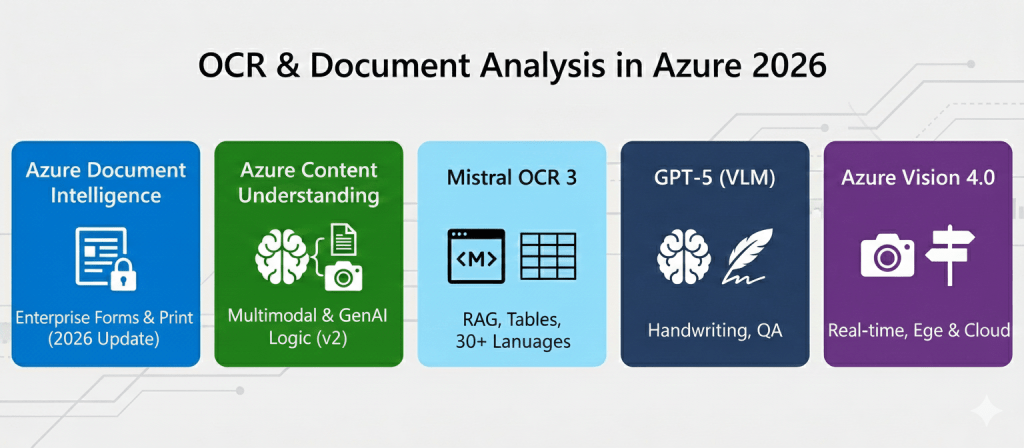
Azure has evolved its OCR offerings into five strategic pillars, each optimized for different workloads:
- Azure Document Intelligence: The battle-tested veteran for structured and semi-structured documents (invoices, forms, IDs). Still leading for printed text.
- Azure Content Understanding: The new multimodal powerhouse (GA since November 2025) that combines OCR with generative AI—handling documents, images, audio, and video.
- Mistral OCR 3: The brand-new state-of-the-art model (December 2025) with a 74% win rate over its predecessor—specifically designed for enterprise-grade OCR with Markdown output.
- GPT-5 / VLM Approaches: Vision Language Models as game-changers—especially strong for handwriting and complex document QA workflows.
- Azure Vision (v4.0): Optimized for “in-the-wild” images like posters or labels via a fast, synchronous API.
1. Performance: Who’s the Accuracy King?
When it comes to raw accuracy, the “best” model depends heavily on your document type. Here’s the current benchmark landscape:
Printed Text
Azure Document Intelligence remains the market leader here, achieving the highest scores in independent benchmarks. For standard forms and clean printed documents, it’s the safest choice.
Multilingual & Tables
Mistral OCR 3 dominates at global scale: 99%+ accuracy across 25+ languages (including German, French, Chinese, Arabic, Hindi) and significantly outperforms standard Azure OCR and GPT-4o in complex table extraction. Benchmarks show 96.6% on tables vs. Textract’s 84.8%.
Handwriting – The Biggest Differentiator!
This is where it gets interesting. Benchmark results vary depending on the test set:
- GPT-5 leads in independent benchmarks for complex handwriting recognition
- Mistral OCR 3: 88.9% accuracy (vs. Azure’s 78.2% in Mistral’s internal tests)
- Azure Document Intelligence: Weaker on pure handwriting, but strong on printed/handwritten mixes
Speed
Mistral OCR 3 is built for velocity, processing up to 2,000 pages per minute on a single node. Azure Vision 4.0 is the choice for real-time UIs where low-latency synchronous responses are required.
⚠️ Important Note: Mistral’s benchmarks are “internal”—conducted by the vendor themselves. Independent comparisons using identical test sets are still lacking. Running your own tests with your document types is essential!
2. Capabilities: Beyond Text Extraction
If you just need raw text, any model works. But if you need intelligence, the field narrows.
Azure Document Intelligence – The Structure Specialist
Doesn’t just give you text—it identifies paragraphs, titles, section headings, and selection marks. Offers pre-built models for specific forms (US Unified Tax, Identity Documents). Ideal when you have fixed, known document types.
Azure Content Understanding – The Logic Layer
- Can generate derived fields—e.g., calculate total tax even if it’s not explicitly written in the document
- Supports multi-file input—validate data across different documents in a single request
- New: Pro mode with reasoning and external knowledge base integration
- Multimodal: Documents, images, audio, video in one service
Mistral OCR 3 – The RAG Optimizer
- Output in Markdown format—massive advantage for RAG pipelines and LLM downstream processing
- HTML-based table reconstruction with colspan/rowspan support
- LaTeX formatting for equations and scientific papers
- Extracts embedded images alongside text
GPT-5 / VLMs – The Reasoning Machines
- Best choice for Document QA: OCR + reasoning in one step
- According to recent studies: VLMs like GPT-5 Mini deliver higher accuracy at lower costs than pure OCR services for complex document intelligence workflows
- Strong on unstructured, visually complex documents
- But: Slower (16-33 seconds per page vs. 2-4 seconds for Azure)
3. Pricing: Tokens vs. Managed Services
Pricing models in Azure Foundry are becoming increasingly flexible:
| Service | Pricing Model | Cost (approx.) |
|---|---|---|
| Document Intelligence | Page-based (tiers) | ~$10 / 1,000 pages |
| Content Understanding | Token-based + PTU option | Pay-as-you-go |
| Mistral OCR 3 | Page-based via Marketplace | $2 / 1,000 pages ($1 batch) |
| GPT-5 (VLM) | Token-based | ~$10 / 1,000 pages |
| Azure Vision 4.0 | Transaction-based | Low (basic OCR) |
💡 Pro Tip: Mistral OCR 3 offers the best price-performance ratio at $1/1,000 pages (batch) for high-volume document digitization.
Comparison Overview at a Glance
| Feature | Doc Intelligence | Content Underst. | Mistral OCR 3 | GPT-5 VLM | Vision 4.0 |
|---|---|---|---|---|---|
| Best For | Standard Forms | Complex/Multimodal | RAG Pipelines | Document QA | Real-time |
| Printed Text | ⭐⭐⭐⭐⭐ | ⭐⭐⭐⭐ | ⭐⭐⭐⭐ | ⭐⭐⭐⭐ | ⭐⭐⭐⭐ |
| Handwriting | ⭐⭐⭐ | ⭐⭐⭐⭐ | ⭐⭐⭐⭐ | ⭐⭐⭐⭐⭐ | ⭐⭐⭐ |
| Tables | ⭐⭐⭐⭐ | ⭐⭐⭐⭐ | ⭐⭐⭐⭐⭐ | ⭐⭐⭐ | ⭐⭐ |
| Multilingual | ⭐⭐⭐⭐ | ⭐⭐⭐⭐ | ⭐⭐⭐⭐⭐ | ⭐⭐⭐⭐⭐ | ⭐⭐⭐ |
| Speed | Fast | Medium | Very Fast | Slow | Very Fast |
| Output | JSON | JSON + Reasoning | Markdown/HTML | Flexible | JSON |
| Reasoning | ❌ | ✅ Native | ❌ | ✅ Best | ❌ |
The Verdict: Which Model for Which Use Case?
📄 Azure Document Intelligence → Fixed form types (insurance claims, ID cards, invoices) requiring reliable, high-accuracy extraction with confidence scores
🧠 Azure Content Understanding → “Messy” documents, wildly varying formats, when logic (calculating, summarizing) needs to be part of the extraction process, or multimodal workflows
🚀 Mistral OCR 3 → Global, multilingual datasets, converting massive amounts of scientific/technical PDFs to Markdown for AI agents, high-volume processing with best price-performance ratio
🤖 GPT-5 / VLM Approach → Complex document QA where OCR + reasoning is needed in one step, best handwriting recognition, unstructured documents
📱 Azure Vision 4.0 → Mobile apps that need to read signs or product labels instantly—lowest latency, synchronous API
Pro Tips for Real-World Implementation
- Test a hybrid approach: GPT-5 Mini + an OCR layer (e.g., Azure Read) can deliver better results for complex QA workflows than pure OCR services alone.
- Test PDF vs. JPEG: Developers report that high-resolution JPEGs sometimes yield better table extraction than direct PDF submission with Mistral OCR.
- Consider DeepSeek OCR for on-prem: If self-hosting or privacy requirements are important, DeepSeek OCR (October 2025) is a relevant alternative.
- Use the Batch API: Mistral OCR 3 offers a 50% discount for batch processing—ideal for archive digitization projects.
- Run your own benchmarks: Vendor benchmarks are self-reported. Test with your actual documents!
💡 Think of picking an OCR model like choosing a specialized lens for a camera: a macro lens for the fine print of a contract, a wide-angle lens for complex multimodal reports, and a telephoto lens when you need to reason about what you’re seeing from a distance.
For a modern AI agent, the combination of Mistral OCR 3 (for fast, affordable bulk extraction) + Azure Content Understanding (for reasoning) or GPT-5 (for complex QA) is the most future-proof choice.
 jannikreinhard.com