
Azure AI Search and Foundry IQ
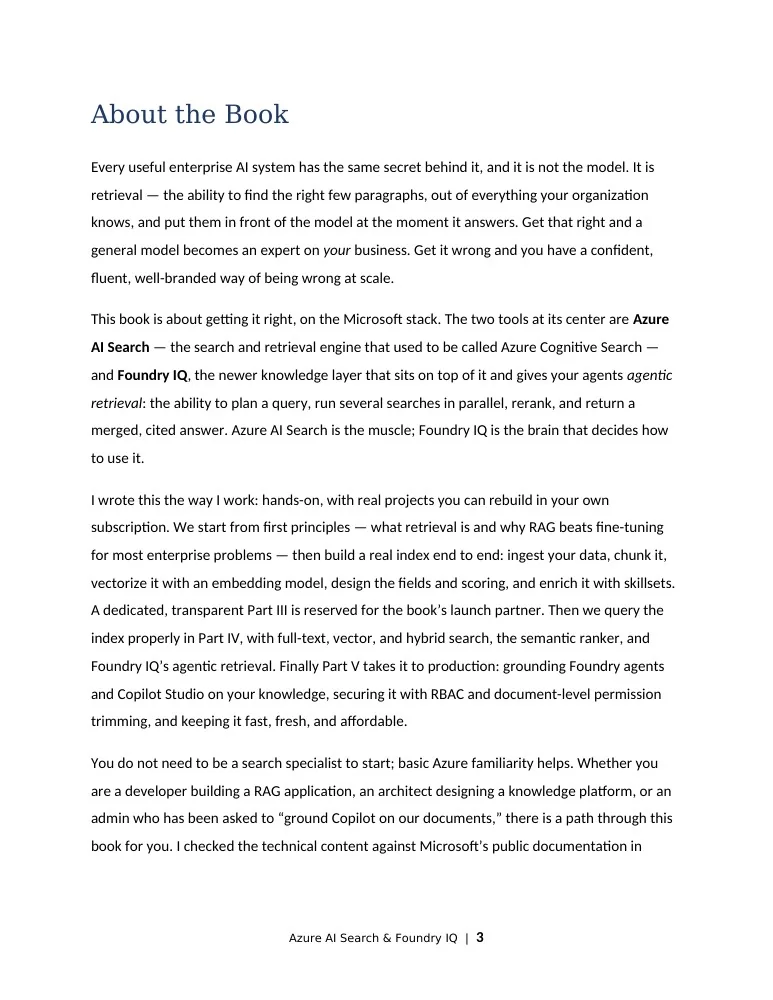
Azure AI Search and Foundry IQ focuses on grounding AI answers in your own data. The book covers chunking, embeddings, hybrid search and reranking, followed by permissions, evaluation and monitoring.
3 complete books · English PDFs · Free

Supported byAdvertisement



What this book covers
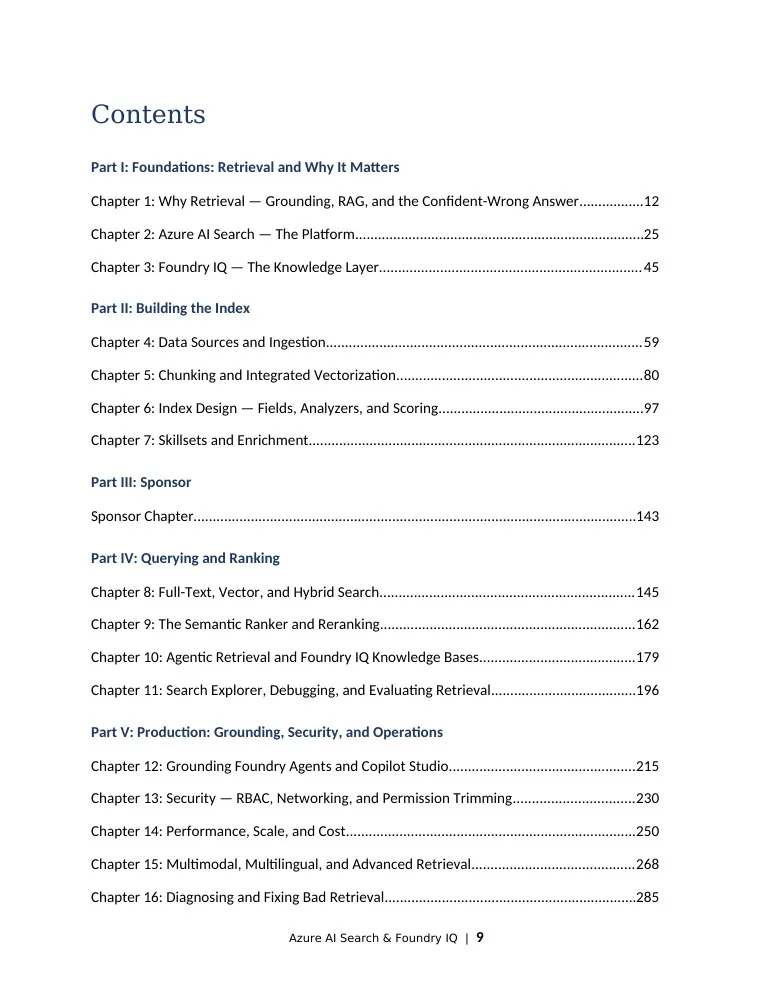
Preview the chapters and example pages from Azure AI Search and Foundry IQ below. The signup form explains how to receive the complete English edition.
320 pagesTopics and examples
Give your AI answers a foundation in your own data.
- Chunking, Embeddings & Hybrid Search
- Retrieval, Reranking & Foundry IQ
- Permissions, evaluation & monitoring
Build a knowledge index
The book follows a search index from data ingestion to querying. It explains how to split documents into chunks, generate embeddings, design fields and scoring, and enrich content with skillsets. These steps connect the source documents to the information an application can retrieve. The examples are intended for rebuilding in an Azure subscription.
Retrieve answers and plan production
The querying sections cover full-text, vector and hybrid search, semantic ranking and agentic retrieval with Foundry IQ. Later chapters connect the knowledge source to Foundry agents and Copilot Studio. They also cover RBAC, document-level permissions, freshness, performance and cost. Basic Azure familiarity helps; a specialist background in search is not required for the opening sections.
The complete English edition, including all chapters and code examples.
See sample pages
Test retrieval before connecting an agent
Start with a small document collection that you know well. Prepare questions about facts in those documents, one question whose answer spans two passages, and one that the collection cannot answer. Keep a note of the expected document for each answer. This gives you a reference when you work through the chapters on ingestion, chunking and index design.
Inspect what reaches the index before judging a generated answer. Check a source document, the resulting chunks and the fields available for retrieval. Work through full-text, vector and hybrid queries using the same questions. Compare the passages they return and record where the expected source is missing. Then use the sections on ranking and reranking to investigate that difference. Changing several settings together makes it harder to understand which change improved a result.
Once retrieval returns useful evidence, follow the integration chapters to connect it to an agent. Check whether the response uses the retrieved information and whether a reader can identify its source. Include an identity that should not see a document in your permission tests. The later chapters on freshness, performance and cost help you plan how the collection will be updated and operated. Keep the question set and your observations with the companion code so that you can repeat the checks after changing documents or index settings.